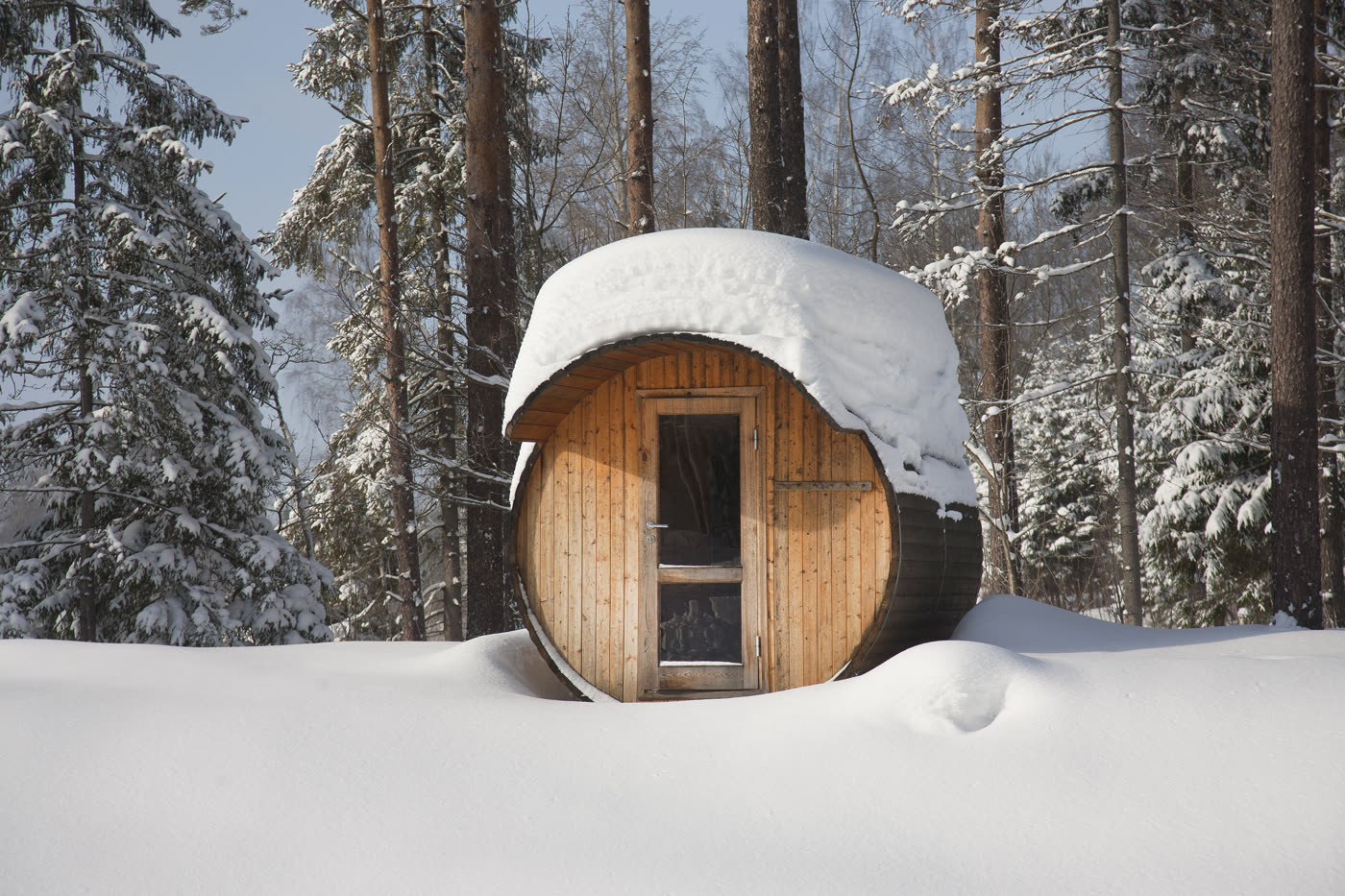

If you live where winter means snow, wind, ice, or long stretches below freezing, “What is the best outdoor sauna?” is the wrong first question.
A better question is: Which outdoor sauna has the right structure, weather protection, heater, foundation, ventilation, and service plan for my climate and property?
The best cold-climate outdoor sauna is not automatically a barrel, cabin, pod, electric model, or wood-fired model. It is the sauna whose complete system works together: the room sheds water, limits uncontrolled heat loss, drains and dries after use, stands on a stable base, matches the heater manufacturer’s specifications, and can be safely installed and maintained where you live.
This guide gives you a practical framework for comparing those systems. It does not rank unverified products or promise that one design works everywhere. Manufacturer instructions, product certifications, local code, site conditions, and qualified trades still control the final decision.
Quick answer: what should a cold-climate buyer prioritize?
For frequent winter use, prioritize these eight factors:
- A weather-shedding shell: a complete roof strategy, protected openings, durable exterior materials, and details that move rain and melting snow away from the structure.
- A well-matched enclosure: walls, ceiling, door, and glazing that are designed as one thermal system rather than a collection of attractive parts.
- A correctly sized heater: selected from the manufacturer’s room-volume and surface-area guidance, not from a generic “bigger is better” rule.
- A stable, draining foundation: level support that handles the sauna’s loaded weight and keeps runoff, snowmelt, and splash water from collecting under it.
- Purposeful ventilation and drying: openings and operating instructions designed for the heater and room—not improvised after installation.
- Verified installation requirements: clearances, electrical service or chimney details, controls, barriers, and listed components that match the exact model.
- Realistic winter access: a safe route for people, maintenance, snow removal, fuel if applicable, and emergency access.
- A written ownership plan: inspection, cleaning, stone care, exterior care, snow management, and warranty requirements.
If you are still comparing the broad categories, start with our Best Outdoor Saunas for Home guide. Then use this article to pressure-test your shortlist for a colder environment.
What “best” means when winter is part of the purchase
Many outdoor-sauna comparisons focus on appearance, capacity, price, or maximum temperature. Those factors matter, but cold climates add a second layer of questions.
The sauna may begin each session at a much lower temperature. Wind can increase heat loss at exposed surfaces. Snow and rain become liquid water during thaws. Freeze-thaw cycles can expose weak drainage and site preparation. Doors, roof transitions, fasteners, seals, electrical components, and exterior finishes all spend months in changing conditions.
That means a cold-climate comparison should consider four forms of performance:
1. Heat performance
Can the sauna reach and maintain the operating range specified by its manufacturer without forcing the heater to compensate for a poorly matched room? Room volume is only the starting point. Glazing, uninsulated surfaces, door construction, ceiling geometry, and outdoor starting temperature may influence real-world warm-up and recovery.
2. Weather performance
Does the exterior assembly shed water and protect vulnerable transitions? A sauna can feel excellent inside and still have a weak roof detail, exposed end grain, poor drainage, or an installation method that does not match the site.
3. Ownership performance
Can you realistically inspect, dry, clean, and maintain it through winter? A design that is difficult to access or clear after a storm may become a burden even if it performs well on a mild day.
4. Project performance
Can the sauna be delivered, permitted, powered or vented, installed, and serviced on your property? The product price does not answer questions about panel capacity, trenching, a foundation, a chimney, crane access, inspections, or snow-management space. Our home sauna cost guide explains why those project costs belong in the buying decision.
Define “cold climate” for your property before comparing products
“Cold climate,” “all season,” and “winter ready” are not engineering specifications. Replace those labels with conditions tied to your site: local winter design temperatures, snow accumulation, wind exposure, elevation, freeze-thaw patterns, wind-driven precipitation, and—where relevant—coastal salt or wildfire exposure.
The ASCE Hazard Tool can help professionals locate site-specific hazard information such as wind, snow, ice, rain, flood, seismic, and other environmental data.[11] It does not approve a sauna, select the governing code edition, or replace the local building department or a qualified design professional.
Before requesting quotes, assemble a one-page site brief with the property address, elevation, access constraints, expected foundation location, utility route, setbacks, and any design criteria supplied by the local authority. Give that brief—and the sauna manufacturer’s drawings—to the installer or reviewer. This turns “Will it work in winter?” into a set of questions that can actually be checked.
Cabin, barrel, or another shape: which is best in cold weather?
Shape matters, but construction details matter more.
Cabin-style outdoor saunas
A cabin-style sauna often gives designers straightforward wall and ceiling cavities, conventional roof geometry, and more usable vertical wall area. Those characteristics can make it easier to specify insulation, interior cladding, exterior weather protection, benches, controls, and service routes as distinct layers.
Potential advantages for cold-climate shoppers include:
- clear roof and drainage options;
- conventional rectangular interior space;
- easier comparison of wall and ceiling assemblies;
- more flexibility for changing-room or porch configurations;
- predictable placement of doors, windows, lights, and controls.
The tradeoff is that “cabin” describes a shape, not a quality standard. You still need to verify the exact wall, ceiling, floor, roof, window, door, ventilation, and foundation details.
Barrel saunas
Barrel saunas use curved walls and a compact enclosure that many buyers find attractive. Their shape can reduce the amount of interior air compared with a larger rectangular structure of similar footprint. However, benches, headroom, weather protection, door fit, and the treatment of the curved exterior vary substantially.
In snowy or wet regions, ask whether the quoted package includes a complete roof or weather membrane, how water is directed away from seams and end walls, what exterior maintenance is required, and whether snow accumulation changes any operating or maintenance instructions. Do not assume the curved wood shell is the entire weather strategy.
Our Best Barrel Saunas buyer checklist covers additional red flags and purchase questions.
Pods and other curved designs
Pod, raindrop, and hybrid designs may add a pitched or extended roofline to a curved room. That can be useful, but the name alone does not tell you how the roof, walls, door, base, and heater are engineered. Compare the actual drawings and manuals rather than relying on the silhouette.
The practical conclusion
For a cold climate, do not select by shape first. Select by the complete assembly:
- roof and water management;
- wall and ceiling design;
- door and glazing area;
- heater match;
- ventilation plan;
- foundation requirements;
- documented clearances;
- exterior care;
- warranty exclusions.
A carefully specified barrel can be a better purchase than a poorly built cabin. A well-designed cabin can be a better fit than a barrel whose weather package is incomplete. The label is not the evidence.
Insulation: compare the whole enclosure, not one advertised number
Cold-climate shoppers often ask for the highest insulation value. That is understandable, but one number cannot describe the full room.
Heat moves through walls, ceiling, floor, door, windows, joints, and air leakage paths. A heavily insulated wall does not erase the effect of a large glass area or a frequently opened door. A strong heater does not correct water trapped in an exterior assembly. A vapor-control detail that works in one climate or construction system may be inappropriate in another.
Ask the seller for a section drawing or written specification that identifies:
- interior cladding;
- wall and ceiling layers;
- insulation type and location, if used;
- air and vapor-control approach;
- exterior sheathing or cladding;
- roof assembly;
- floor assembly;
- window and door specifications;
- penetrations for vents, lights, controls, wiring, or chimney components.
Then ask who is responsible for adapting those details to your climate and local requirements. If the answer is “the installer,” confirm that the installer has the drawings before you order.
The USDA Forest Products Laboratory’s Wood Handbook is a useful general reference for understanding that wood dimensions, moisture, durability, finishes, and decay risk are linked to species, environment, construction, and maintenance—not just marketing names.[1] It is not a sauna installation manual, but it explains why water management and drying deserve serious attention.
Roof and snow management: treat water as a design problem
In a cold climate, snow is stored water. During sun exposure, heater operation, or a thaw, that water moves.
A buyer should be able to answer:
- What is the primary roof surface?
- Where does runoff go?
- Are doorways or vents below a drip line?
- Are roof edges, penetrations, and transitions flashed or otherwise protected?
- Does the manufacturer specify snow removal?
- Are there maximum snow-load or site limitations?
- Can you safely clear snow without damaging the sauna?
- Does runoff refreeze on the path to the door?
Do not add a site-built roof, membrane, flashing detail, or coating without checking the manufacturer’s instructions and warranty. A modification that seems protective may trap moisture, block ventilation, interfere with service, or change warranty coverage.
Also examine the surrounding site. Roof runoff should not discharge onto electrical equipment, stairs, a walkway, or the base. Leave enough space to inspect exterior walls and remove snow. A sauna squeezed tightly against a fence may be difficult to maintain and may conflict with local setbacks or service-clearance requirements.
Foundation and drainage: solve the ground before the sauna arrives
A premium sauna on an unstable base is still an unstable project.
The correct foundation depends on the sauna’s weight, footprint, manufacturer instructions, soil, slope, frost conditions, drainage, and local rules. Possible solutions include engineered slabs, piers, approved deck structures, paver systems, or compacted aggregate assemblies, but those are categories—not interchangeable recipes.
Before ordering, verify:
- total unit weight and occupied load;
- required support points;
- allowable tolerances for level;
- anchoring requirements;
- frost-depth considerations;
- soil and drainage conditions;
- whether a deck is designed for the load;
- route and protection for electrical or fuel systems;
- access for delivery equipment;
- water movement during rain and snowmelt.
A “flat-looking” yard is not a foundation specification. Get the sauna’s actual base drawing and give it to the person designing or approving the site.
Pay attention to drainage around—not only inside—the sauna. Water should not pond under the structure or repeatedly splash the lowest wood components. In freezing weather, poorly directed water can also create an unsafe approach.
Heater sizing: use the exact manufacturer’s method
A common cold-climate mistake is choosing a heater from floor area alone. Heater manufacturers normally size equipment using room volume and may require adjustments for glass, masonry, or other uninsulated surfaces. HUUM’s heater-sizing guidance, for example, explicitly treats room size and uninsulated surfaces as inputs.[2] Other manufacturers use their own tables and rules.
Use this sequence:
- Calculate the finished interior volume from the actual drawings.
- Identify glass, masonry, or other surfaces the heater manufacturer treats as additional load.
- Confirm the heater’s permitted room-volume range.
- Confirm supply voltage, phase, breaker, conductor, controls, sensors, and disconnect requirements for the exact regional model.
- Confirm required clearances and protective barriers from the installation manual.
- Ask how outdoor starting conditions affect expected warm-up—not whether the heater can ignore the manual’s room range.
- Have the qualified installer verify the selection before purchase.
Oversizing is not a universal fix. A heater and room must be an approved match, and controls and sensors must be installed where the manufacturer specifies. Do not move a sensor to “improve” performance or reduce clearances because a room feels slow to heat.
When a brand claims a heater is certified or listed, verify the exact model and regional configuration. UL describes certification services for heating products, and its Product iQ database is one place to research UL certifications.[3][4] A logo in a product image is not a substitute for matching the model number and documentation.
Electric or wood-fired: compare the entire installation
Both electric and wood-fired heaters can be part of an outdoor sauna. Their project requirements are very different.
Electric heat
Electric heaters can offer straightforward controls and avoid storing fuel or managing combustion. However, the installation may require a dedicated circuit, sufficient service capacity, approved outdoor wiring methods, controls, sensors, disconnects, and electrical work by a qualified professional.
Before ordering, obtain the exact electrical specification and ask an electrician to evaluate the route from the service to the sauna. Long runs, trenching, panel upgrades, local inspection, and control placement can materially change cost and schedule.
Wood-fired heat
Wood-fired heaters add fuel storage, ash handling, combustion air, chimney components, roof or wall penetrations, spark and fire concerns, and local restrictions. The stove and chimney system must be treated as a matched installation, not as decorative accessories.
The U.S. Environmental Protection Agency’s Burn Wise program recommends choosing appropriately sized wood-burning equipment and following cleaner-burning practices.[5][6] Those resources are broader than saunas, but they reinforce two useful buying principles: do not select combustion equipment only by maximum output, and do not ignore fuel quality, operation, emissions, or maintenance.
Ask the local authority having jurisdiction, installer, insurer, and manufacturer what is required for your exact property. Wildfire-prone regions, burn restrictions, setbacks, chimney height, clearances, and insurance conditions may affect whether wood-fired heat is practical.
Door and glazing: every view has a thermal and usability tradeoff
Glass can make a small sauna feel open and connect it to the landscape. It also changes the room’s heat-loss profile, which is why heater-sizing methods may account for uninsulated surfaces.
Compare:
- total glass area, not just the number of windows;
- glass type and safety specification;
- door swing and emergency egress;
- threshold and ice exposure;
- seals and hardware;
- manufacturer adjustments to heater sizing;
- privacy and nighttime visibility;
- replacement availability.
A door that drags, swells, freezes at the threshold, or opens onto an icy landing can become a daily problem. Look at the entrance as part of the site plan: roof drip line, lighting, handholds, steps, drainage, and snow storage all matter.
Ventilation and drying: do not improvise vent placement
Ventilation affects comfort, heater operation, temperature distribution, and drying. It is also one of the easiest details to oversimplify.
The right configuration depends on the heater type, controls, room geometry, bench layout, and manufacturer instructions. HUUM’s ventilation guidance distinguishes between natural and mechanical approaches and emphasizes the relationship between supply and exhaust locations.[7] Treat that as educational context, then follow the manual for the equipment you actually purchase.
Ask for a drawing that shows:
- fresh-air inlet;
- exhaust or drying outlet;
- heater and sensor positions;
- bench heights;
- door undercut, if part of the design;
- mechanical fan, if specified;
- how the room is dried after use.
Do not close a vent because the room warms slowly. That can conceal a sizing or installation problem and may conflict with the heater instructions.
After a session, follow the manufacturer’s drying procedure. Remove excess water as directed, allow benches and floor surfaces to dry, and avoid leaving wet textiles inside. If the room repeatedly develops persistent odor, visible growth, staining, or trapped moisture, stop treating it as a cleaning-only issue and investigate drainage, ventilation, leaks, and operating procedure.
Materials and hardware: ask what is structural, interior, and exposed
“Cedar sauna” or “Thermowood sauna” may describe only part of the assembly. Request a component-level material schedule.
Identify:
- interior wall and ceiling cladding;
- bench and backrest material;
- exterior cladding;
- framing or structural shell;
- floor and duckboard;
- roof materials;
- fasteners and connectors;
- door frame and hardware;
- coatings or finishes;
- heater guard.
Interior surfaces must be appropriate for sauna temperatures and skin contact. Exterior surfaces must withstand the site exposure and the manufacturer’s care plan. Hardware should be suitable for its environment and location.
Do not apply an interior stain, exterior sealer, caulk, or other coating simply because it is labeled “weatherproof.” Confirm allowed products and surfaces in writing. Some finishes can create odor, become uncomfortable at temperature, interfere with drying, or void a warranty.
Winter usability: plan the path, not only the room
An outdoor sauna can be beautifully built and inconvenient to use.
Walk the complete winter journey:
- Where do users change or store robes and footwear?
- Is the route lit without glare?
- Who clears snow, and where is it stored?
- Can runoff refreeze on steps or the landing?
- Is there a handrail where needed?
- Can the door open fully after a storm?
- Can emergency services reach the area?
- Can a technician access the heater, controls, electrical equipment, or chimney?
- If wood-fired, can fuel remain dry and be carried safely?
- Is there a safe cool-down area protected from traffic and severe weather?
Convenience also affects maintenance. If exterior panels, drains, vents, or equipment are inaccessible for months, small issues may become expensive ones.
A cold-climate comparison scorecard
Use this scorecard for every model on your shortlist. Replace vague answers with document names, drawing numbers, and responsible parties.
| Decision area | Evidence to request | Red flag |
|---|---|---|
| Climate suitability | Written outdoor-use and climate limitations | “All-weather” with no supporting manual |
| Roof | Roof specification and runoff path | Roof treated as an optional cosmetic accessory |
| Enclosure | Wall, ceiling, floor, door, and glazing details | One insulation claim with no assembly drawing |
| Heater | Exact model, room range, clearances, controls | Selection based only on floor area |
| Certification | Verifiable model listing/certification | Unmatched badge or certificate |
| Foundation | Base drawing, loads, anchoring, tolerances | “Any flat surface works” |
| Ventilation | Manufacturer-approved vent plan | Installer plans to decide after assembly |
| Electrical | Load and wiring documentation | No pre-purchase electrician review |
| Wood-fired system | Stove, chimney, clearances, local approval | Generic chimney package with no site review |
| Maintenance | Written interior, exterior, stone, and winter care | Warranty requires care that is not documented |
| Delivery | Crate size, weight, access, unloading responsibility | Freight arrives before site-access planning |
| Warranty | Structure, heater, controls, labor, weather exclusions | Weather damage excluded while care is undefined |
Questions to ask before paying a deposit
- Is this exact model approved by the manufacturer for year-round outdoor installation in my climate?
- What are the documented temperature, snow, wind, altitude, or coastal limitations?
- What roof system is included?
- What wall, ceiling, floor, door, and glazing assemblies are included?
- Which heater model is quoted, and how was it sized?
- What certification or listing applies to that exact model and regional configuration?
- What clearances must remain around the heater, structure, controls, and chimney?
- What foundation drawing and loaded weight should my contractor use?
- What ventilation configuration does the manufacturer require?
- What electrical service or combustion system is required?
- Who handles permits, inspections, trenching, foundation, crane or forklift access, assembly, and commissioning?
- What must I do after each winter session to dry the room?
- What exterior maintenance is required, with which approved products?
- Which forms of weather, moisture, foundation movement, corrosion, or improper installation are excluded from warranty coverage?
- Who provides service and replacement parts in my area?
If a seller cannot provide the manual, drawings, heater model, and warranty before purchase, you do not yet have enough information to compare the product responsibly.
Winter operating and maintenance checklist
Always follow the product instructions, but a general inspection routine can include:
Before the cold season
- inspect roof, flashing, exterior surfaces, and penetrations;
- confirm drainage routes are open;
- check door operation and hardware;
- inspect electrical or chimney components through qualified professionals as applicable;
- review heater stones and maintenance intervals;
- test lighting and the access path;
- confirm approved snow-removal methods;
- restock only permitted cleaning and care products.
Before a session
- clear the approach and door swing;
- check for roof or site hazards from snow and ice;
- inspect the room and heater area for stored objects;
- verify vents are in their operating positions;
- operate the heater only as instructed;
- never use the sauna as a drying or storage room while heating.
After a session
- follow the manufacturer’s cool-down and drying procedure;
- remove wet towels and standing water;
- leave vents, door, or mechanical drying system as specified;
- allow surfaces to dry before closing the room for an extended period;
- note unusual odor, discoloration, control errors, leaks, or slow warm-up.
HUUM’s heater-maintenance guidance is one example of why stones and heating elements need periodic attention rather than “set it and forget it” ownership.[8] Use the schedule for your exact heater.
Safety and wellness claims: keep expectations realistic
A sauna is a high-heat environment, not a medical treatment. Reviews of sauna research report potential associations and physiological effects, but they also note limitations in the evidence and the need for more research.[9][10] Those studies do not prove that a particular consumer sauna prevents or treats disease.
Follow the safety instructions for the sauna and heater. Ask a qualified healthcare professional whether sauna use is appropriate for you, especially if you are pregnant, have cardiovascular or blood-pressure concerns, take medications that affect heat tolerance or hydration, or have another relevant medical condition. Never combine sauna use with impairment, and supervise children according to medical guidance and product rules.
For practical use precautions, see our Sauna Safety for Beginners.
Frequently asked questions
Are barrel saunas good in cold climates?
They can be, but the answer depends on the exact shell, roof or weather membrane, door, glazing, heater match, ventilation plan, foundation, site exposure, and maintenance requirements. Do not treat the barrel shape itself as proof of winter performance.
Does an outdoor sauna need insulation?
Some outdoor-sauna systems use insulated assemblies; others rely on different wall systems and heater-room combinations. Compare the complete manufacturer-designed enclosure and its documented climate limitations. Do not add insulation or vapor-control layers without an approved design.
Should I buy a larger heater for winter?
Use the heater manufacturer’s sizing method for the completed room, including any adjustments for glazing or other uninsulated surfaces. Have the selection verified before purchase. Choosing beyond the approved room range is not a substitute for fixing a poor enclosure or installation.
Is electric or wood-fired better in snow country?
Neither is universally better. Electric heat may offer convenient controls but can require service upgrades, trenching, and electrical permits. Wood-fired heat can work where appropriate but adds fuel, chimney, combustion, emissions, maintenance, fire-safety, and local-rule considerations. Compare the full installed system.
What is the best foundation for an outdoor sauna in a freezing climate?
There is no universal foundation. The answer depends on the sauna’s loads and support points, soil, slope, drainage, frost conditions, deck capacity if applicable, manufacturer requirements, and local code. Use the product’s base drawing and professional site guidance.
Can an outdoor sauna stay outside all winter?
A model designed and installed for year-round outdoor use can remain outdoors subject to its manual, climate limitations, maintenance, and warranty. Verify snow, wind, moisture, drainage, freeze-thaw, roof, and service requirements for the exact model.
How long will an outdoor sauna take to heat in winter?
There is no reliable universal time. Heater output, room volume, glazing, insulation, air leakage, ventilation, starting temperature, wind exposure, voltage, stone condition, and target temperature can all matter. Ask for documented test conditions and treat unsupported warm-up promises cautiously.
Final recommendation
The best outdoor sauna for a cold climate is the one you can verify—not the one with the strongest adjective.
Start with the site and winter-use plan. Compare complete enclosure drawings, not one insulation claim. Match the heater using the manufacturer’s method. Verify certification and installation documentation for the exact model. Resolve foundation, drainage, electrical or chimney work, ventilation, access, and permits before delivery. Finally, read the maintenance and warranty terms as carefully as the product page.
That process may not produce the same answer for every buyer. It should produce a safer, more durable, and more defensible shortlist for your property.
Use the SaunaBoxes quiz to clarify your preferred format, then bring the resulting category back to this cold-climate checklist before you order.
Sources and references
- USDA Forest Products Laboratory, Wood Handbook: Wood as an Engineering Material: https://research.fs.usda.gov/fpl/wood-handbook
- HUUM, “Sauna Heater Size Calculator: How to Choose the Right Power Rating for Your Sauna”: https://huumsauna.com/sauna-heater-size-calculator-how-to-choose-the-right-power-rating-for-your-sauna/
- UL Solutions, “Heating Products”: https://www.ul.com/industries/products-and-components/hvacr/heating-products
- UL Solutions, “Finding UL Listed and Certified Products with UL Product iQ”: https://www.ul.com/thecodeauthority/knowledge/ul-listed-certified-database-product-iq
- U.S. Environmental Protection Agency, “Choosing the Right Wood-Burning Stove”: https://www.epa.gov/burnwise/choosing-right-wood-burning-stove
- U.S. Environmental Protection Agency, “Best Wood-Burning Practices”: https://www.epa.gov/burnwise/best-wood-burning-practices
- HUUM, “Sauna Ventilation: What Are the Most Important Considerations?”: https://huumsauna.com/sauna-ventilation-what-are-the-most-important-considerations/
- HUUM, “Sauna Heater Maintenance: A Complete Guide to Sauna Stone and Heating Element Care”: https://huumsauna.com/sauna-heater-maintenance-a-complete-guide-to-sauna-stone-and-heating-element-care/
- Hussain, J., and Cohen, M., “Clinical Effects of Regular Dry Sauna Bathing: A Systematic Review,” Evidence-Based Complementary and Alternative Medicine (2018): https://pubmed.ncbi.nlm.nih.gov/29849692/
- Laukkanen, J.A., Laukkanen, T., and Kunutsor, S.K., “Cardiovascular and Other Health Benefits of Sauna Bathing: A Review of the Evidence,” Mayo Clinic Proceedings (2018): https://pubmed.ncbi.nlm.nih.gov/30077204/
- American Society of Civil Engineers, ASCE Hazard Tool: https://ascehazardtool.org/